NOVELS - Conceived and Written by Ram Kandaswamy
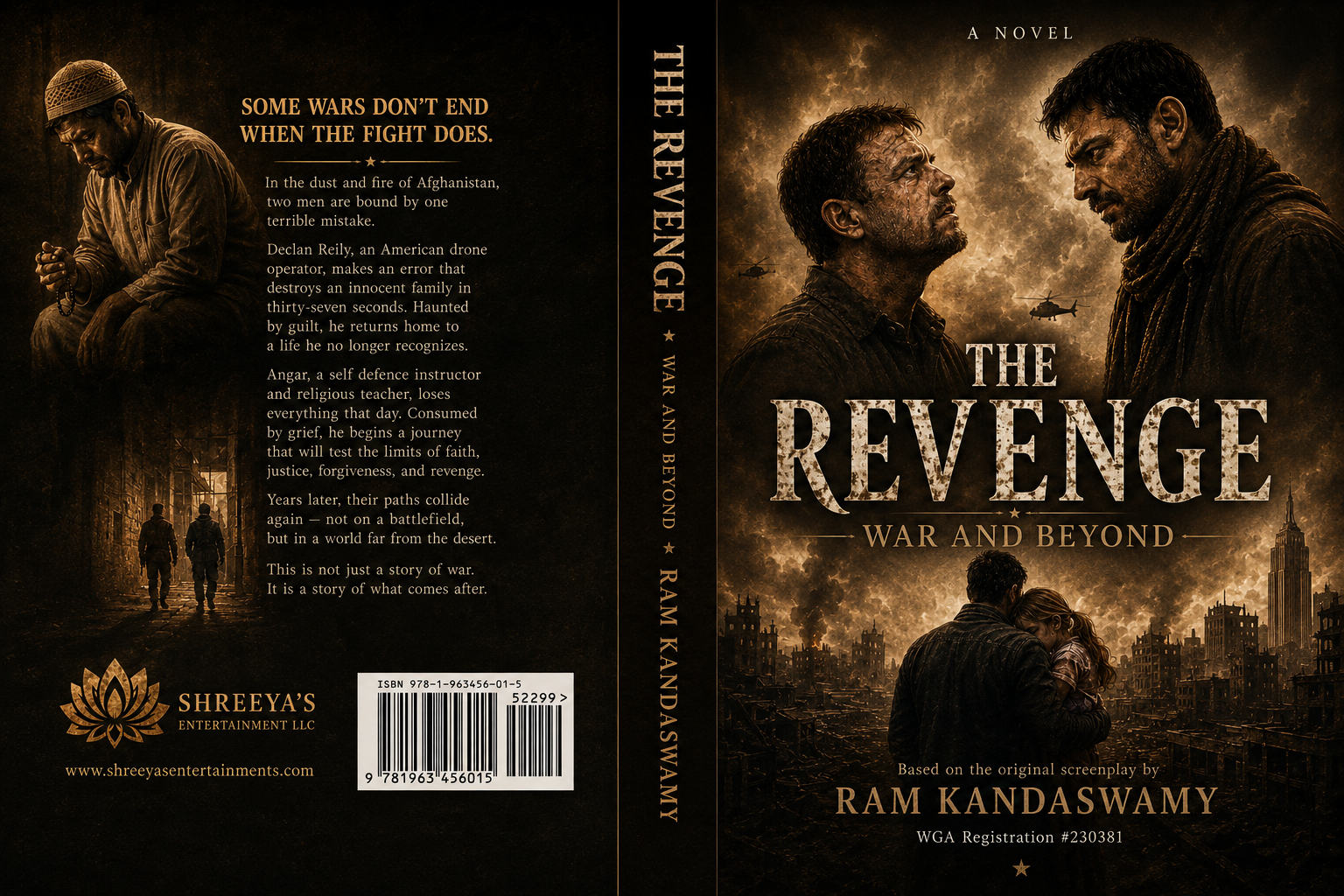
In the dust and fire of Afghanistan, two men are bound by one terrible mistake. Declan Reily, an American drone operator, makes an error that destroys an innocent family in thirtyseven seconds. Haunted by guilt, he returns home to a life he no longer recognizes. Angar, a self defence instructor and religious teacher, loses everything that day. Consumed by grief, he begins a journey that will test the limits of faith, justice, forgiveness, and revenge. Years later, their paths collide again - not on a battlefield, but in a world far from the desert. This is not just a story of war. It is a story of what comes after.
When a revenge-driven father’s drone strike obliterates another father’s family, their families and the systems surrounding them seek to shape who they become. Caught in a web of espionage, they must decide whether they can break the cycle of revenge.
Genre: Drama, Psychological thriller

In 1773 Boston, a rougue dock boy wants to be respected. He meets a high class Merchant’s daughter who is ahead of her time. How do they inspire each other to make history together but still be left out of the history books.
In 1773 Boston, a rougue dock boy wants to be respected. He meets a high class Merchant’s daughter who is ahead of her time. How do they inspire each other to make history together but still be left out of the history books.
Genre: Coming of Age, Historical
NOVEL PREVIEW
The Revenge
When revenge upends the lives of two fathers, their families and the systems around them reshape who they become. Caught in a web of espionage, they must decide whether they can rise above those forces.
Genre: Drama, Psychological thriller

-
CHAPTER ONE
THE EX-KNIGHT
The waiting room had four chairs, a low table with last month's magazines fanned in a way that suggested someone straightened them every morning without really expecting anyone to read them, and a window that looked south toward Lower Manhattan. Declan Reily had been standing in front of that window for ten minutes without seeing anything in it.
He was seeing coordinates. 31.6272 North, 65.4556 East. The numbers appeared on the inside of his eyes the way certain things do when they have been looked at too many times — not remembered, just present, the way a scar is present, the way you don't choose to look at it but there it is.
Below the window, the city moved through its morning, unbothered by what he was carrying, the way it moved through every morning.
A woman in a good wool coat and a man pushing a shopping cart loaded with cans and folded cardboard waited at the same crosswalk, the light between them red, then not. They walked. A bus exhaled at the curb.
Somewhere below, a delivery guy was arguing cheerfully with a doorman about a package neither of them seemed to actually want to resolve, the argument itself apparently more satisfying than winning it.
Manhattan — the one city where the rich and the homeless genuinely had to share the same pavement, where walking was sometimes the only option regardless of how much money you had. He had grown up in one of her suburbs.
He knew her bone-deep, knew which blocks got shadow first in the afternoon and which diner on the Upper West Side actually made coffee worth drinking (there were only two, and neither of them advertised it), knew what the air through the subway grates smelled like before rain — a specific mineral warmth, like a held breath about to be let go.
He had come back to her three years ago, broken in a way that was not visible from the street, and she had absorbed him without comment, the way she absorbed everything: the good, the ruined, the ordinary, all of it swallowed into the same indifferent rhythm of buses and crosswalks and delivery arguments.
The receptionist's desk sat off to the side of the waiting room, half-hidden behind a potted plant that had seen better decades.
Amy manned it most mornings — mid-forties, cardigan weather year-round regardless of the actual weather, a coffee mug that said WORLD'S OKAYEST ASSISTANT that someone had clearly bought her as a joke and that she'd clearly decided to keep using in earnest.
She'd been humming something under her breath for the last several minutes, low enough that Declan couldn't place the tune, just present enough to register as company.
"Major! Dr. Sheila will see you now."
His heart jumped on the word. One full beat of shame, the physical sensation of it landing behind his sternum — not pain exactly, more like pressure on a bruise that never quite finished healing, that flared at the lightest touch and then settled back into its low, permanent ache.
He turned.
Amy held the door to the therapy rooms with the cheerful efficiency of someone who did not know what the word cost him every single time she said it — who had no way of knowing, because he'd never told her, because it wasn't her fault, because she was simply a kind woman doing her job the way she'd always done it, and the title just happened to land on him like a small stone every week.
"Thanks, Amy."
"You're welcome, Major." She said it warmly. She always said it warmly. That was somehow the part that got him — not the word itself, but the genuine goodwill behind it, offered to a man she believed, reasonably, deserved to be called by his rank.
Another one. He kept walking.
That was why he was here. In a shrink's office, on a gray Tuesday in January, in a building that smelled faintly of the dry-cleaner two floors down.
For a mistake he'd made a long time ago — for thirty-seven seconds in 2004 in a windowless room in Kandahar, where he'd been a drone operator, made a judgment call, been one degree off in thirty-five-knot gusting winds, and destroyed not the cell gathering he'd been sent to destroy but a birthday party.
He had killed forty people.
Women. Children. Four generations of a single family. Forty people gone in thirty-seven seconds, in the particular efficient fashion of modern warfare that is designed to keep the operator clean and remote and thereby makes the thing more psychologically available afterward, not less. You don't have to be near what you've done. You just have to live with having done it.
Three years of living with it. Three years of Tuesdays like this one.
The therapy room was small and unremarkable in the specific way that therapy rooms are engineered to be unremarkable — a long couch the color of oatmeal, a chair angled just slightly away from direct confrontation, a lamp with a warm bulb instead of a cold one, a low table with a box of tissues that had clearly been refilled that morning, the top one folded into a neat little peak.
He lay down on the couch and looked at the ceiling. The ceiling was plain white, unoccupied, not trying to be anything.
There was a hairline crack near the light fixture that he'd noticed maybe a year ago and had watched, with the patient attention of a man who has very little else to do while lying on a couch, not lengthen by so much as a millimeter since. He stared at it now.
He had stared at a lot of ceilings in three years of sessions. This one knew things about him.
In the silence — the weighted silence of a room designed to hold difficult things — his mind went where it always went when he stopped managing it. A specific monitor. A specific set of coordinates. The thermal image in ghostly heat-signature green: a lone figure in the rubble, moving on its knees through ash. The ops tech's voice, very quiet:
Off by a degree.
Then a knock. Two soft raps, the same rhythm every week, so familiar by now that his body had started responding to it before his mind caught up.
"This is Dr. Sheila. May I come in?"
"Yes, please. I've been waiting for you."
She came in without hurry, the way she always came in — as if she had all the time there was, as if the session were not a fifty-minute appointment tracked on some billing system down the hall but a conversation that could go as long as it needed to, world be damned.
She was in her sixties, white-haired, wearing the kind of soft cardigan that seemed to be a professional uniform for women in her line of work, and what he had come to trust about her was not her technique but her steadiness.
She had heard things in this room that had not broken her.
That was the main thing he needed — not answers, not really, just proof that a person could hear the worst thing he'd ever say out loud and still come back next Tuesday, still sit in the same chair, still ask the same gentle questions.
She settled into the chair beside the couch, arranging herself the way she always did, notebook on her lap that she rarely actually wrote in.
"Looks like you started without me."
A dry smile. "Just drifted away."
"Sometimes self-realization helps."
"But it might put you out of a job."
She smiled. He smiled back. The performance of two people who have developed a comfortable routine and use it as the surface beneath which the real conversation can happen — the small jokes a kind of stretching before the harder exercise.
"So," she said. "What would you like to talk about today?"
Declan looked at the ceiling. The crack was still exactly where it had always been.
"It's always the same thing, Doctor."
The air hissed through the vent above the couch, a low continuous whisper that he'd stopped noticing months ago and now noticed again, the way you notice a sound only in the silence right before or right after someone speaks.
In the waiting room, very muffled, Amy answered the phone — something cheerful, something about rescheduling, her voice a distant murmur of ordinary business continuing on the other side of the wall.
"I'm not sure these sessions are doing any good," he said. "I'm doing it for my wife, mostly. And I feel guilty about that too — she's paying for them, and Sara has enough to carry without also carrying the bill for my psychological maintenance."
Dr. Sheila said nothing. This was one of her specific skills — the calibrated silence that said I am here and I heard that and I am waiting, rather than the silence of someone who has nothing to offer. He had learned to read the difference, the way you learn to read the specific quality of quiet in a house depending on who's home.
"It's okay, Mr. Reily. We'll keep working. Breakthroughs rarely announce themselves."
"I have my doubts." He exhaled slowly, the technique she had taught him — in through the nose, hold, out through the mouth longer than felt natural. "That day — when I made my own decision based on the heat pattern — I killed a whole family. Almost forty people. Women and children."
He breathed. She let him breathe. She knew the geography of this — knew he was reliving it as he said it, that the words were not description but re-entry, that the specific images had embedded themselves in him the way shrapnel embeds, rearranging the internal landscape around themselves permanently.
"Only when I see them in heaven and get their forgiveness will I feel better." He paused. "Sometimes I think about the whole point of these wars. Someone at the top of the chain wants to show off, and somebody else pays the debt."
"Relax, Mr. Reily." She said it not as a command but as an invitation. "Everyone has a role in this lifetime. None of us truly know the purpose God assigned us. We only pretend to know."
He slipped out the dry smile again. The smile that was not really a smile — the facial expression of a man too tired to produce the real thing but too polite not to produce something.
"Close your eyes," she said. "I want to try something."
He hesitated. Outside, a truck downshifted somewhere on the avenue, the sound rising and falling away. Then he closed them.
"Good. Now — don't go to the moment itself. I want you to go to what comes after. What does after look like?"
He tried. He found the after. But the after was ash and smoke and a figure on its knees and a specific small temperature, the temperature of something that had recently been warm. He had built the after from the thermal image and from what the intelligence files had told him about who lived at that address, and the after he had built was not the therapeutic kind.
"Breathe shallow," she said. "Let it come."
He breathed. He kept his eyes closed. He held on. The vent hissed above him. Somewhere down the hall, a door opened and closed.
He was not ready yet. But he was closer than he had been six months ago. He could tell because the image had stopped making him physically sick. It had moved from the body into somewhere else, somewhere that was still terrible but was at least sustainable — a room he could stand in now instead of a wave that knocked him down.
"Mr. Reily," she said, "the fact that you can sit with this — that you haven't numbed yourself, that you haven't found a way to stop feeling it — that is not weakness. That is the beginning of the thing on the other side of it."
He opened his eyes. He looked at the ceiling. The crack, the light fixture, the ordinary architecture of a room that asked nothing of him except that he keep showing up to it.
"I'll take your word for it, Doctor," he said.
She smiled at him. Not the performed kind. The kind that had been arrived at through years of sitting with hard things and somehow not being worn down by the sitting.
"Same time Thursday," she said.
He got up slowly, the particular stiffness of fifty minutes spent mostly still. He buttoned his coat.
He went out through the waiting room, past the potted plant that had seen better decades, past Amy's desk, where she looked up and gave him the same small nod she gave him every week — not pity, just acknowledgment, the kind one regular gives another at a place they both happen to frequent — and through the glass door into the January air.
-
CHAPTER TWO
UNDERGROUND
Below the therapy-room window, a man in a dark coat held a coffee he wasn't drinking. Declan would have seen him if he'd looked back.
He didn't. He turned west toward the subway, hands in his pockets, breath fogging in front of him in small, even clouds.
The walk to the station took nine minutes, the same nine minutes it always took, past the dry cleaner and the bodega with the cat that lived in the window and the church whose bells rang the hour a few seconds late, as if perpetually catching up to the rest of the city. The platform was nearly empty at that hour.
The train, when it came, was warm, half-full, and quiet. He found a seat by the window and let his head fall back against the glass. He hadn't slept well in days.
The session had taken something out of him the way sessions always did — not pain exactly, but depletion, the specific tiredness of having gone looking for something in himself and having found part of it.
The train pulled out of the station. Tunnel lights strobed past the window in a steady pulse. He let his eyes close.
Underneath the rocking of the car and the distant screech of the rails, a voice arrived that was not in the car with him.
Commanding. Certain. The voice of a man handing him a file across a table in a windowless room a long time ago.
"Major. 31.6272 North, 65.4556 East."
The tunnel went on being a tunnel. Declan was already somewhere else.
• • •
-
CHAPTER THREE
AM I A WHITE KNIGHT OR BLACK KNIGHT
Somewhere behind his closed eyes, the tunnel gave way to an older year entirely — 2001, a version of Queens and a version of himself he hadn't visited voluntarily in a long time.
The television's cold light washed over their faces on a September evening in Queens, the whole living room gone quiet except for the anchor's voice. A half-drunk glass of water sat sweating a ring onto the coffee table. The remote lay where it had been set down hours ago and not touched since, because neither of them had wanted to be the one to change the channel off of this.
"Today, President Bush signs the Authorization for Use of Military Force in Afghanistan, following the tragic events of 9/11."
Declan sat on the couch with his eyes wet, watching, his own pulse loud enough in his ears that it nearly drowned out the anchor's voice.
Sara sat close beside him, a Midwestern girl not far from her due date, her hand resting on his shoulder in the specific way hands rest on shoulders when there is nothing useful left to say.
Her other hand rested on the round shape of her belly, absent, the way a hand rests on something it has simply gotten used to being there.
"I hope I get to—" He stopped. His lips trembled before the rest of it came. "Take him off the face of the earth."
Sara only squeezed his hand.
"Mom would have been here," Declan said. "She went in just for an early meeting."
Sara winced — a sharp pain low in her belly. His hand tightened around hers without his deciding to tighten it. He felt it happen and his whole tone shifted, the grief shoved somewhere it could wait.
"You okay, Sara?"
"I think it's time."
"Hey. Breathe."
She breathed. He held her hand through it, counting — one, two — until the contraction passed and she exhaled, shaky, into the space after it. Somewhere in the kitchen, the refrigerator hummed on, indifferent, the most ordinary sound in the world arriving at the least ordinary possible moment.
"I'm calling the hospital."
He was up and across the room before he'd finished the sentence, the landline cord stretching taut as he dialed, his thumb catching the wrong digit once and having to start over. As he listened to it ring, somewhere underneath the sound, a different rhythm was already starting — insistent, small, entirely its own.
• • •
The labor room ran on that same rhythm hours later — a fetal heartbeat whooshing in and out, vital monitors keeping their own separate time, the particular fluorescent hum of a hospital at an hour when most of the building has gone quiet except for this one room. A blood pressure cuff hung deflated on its hook. Someone's forgotten clipboard sat on the windowsill.
Sara lay slick with sweat, and Declan held her from behind, his own back doing half the work of holding her upright, his hospital gown sticking to him in places he'd stopped noticing an hour ago.
"One more push, Sara," the doctor said.
She gave it. The baby came into the room crying, and the doctor caught her, clamped the cord, cut it.
"Congratulations. It's a baby girl."
A nurse cleaned her, wrapped her in a blanket gone soft from a hundred other newborns before her, and set her into Declan's waiting arms before he'd fully processed that his arms were already shaped to receive her.
He carried her to Sara, who took her, and he kissed Sara's forehead — salt and sweat and something underneath it he'd remember for the rest of his life without ever being able to name it precisely — and Sara smiled at him in a way that undid something in his chest that grief had been holding shut for days.
"She's gorgeous," he said. "Just like her mother."
Sara blushed. "She has your nose."
He touched the baby's nose, grinning, unable to help it, and the baby's whole tiny face scrunched in mild, dignified protest at the intrusion.
They closed their eyes together.
"Lord, dear God, thank you for blessing us with this baby girl," they said, the words falling into the old rhythm of every prayer either of them had ever said together. "Be her light, her path, and her savior. We pray in the name of the Father, the Son, and the Holy Spirit. Amen."
A quiet beat passed. Somewhere down the hall a cart wheel squeaked, arrhythmic, growing fainter. Declan looked at the two of them, torn in a way that had no clean resolution.
"I wish I didn't have to leave," he said.
Sara exhaled. "For Mom?"
He nodded.
He slipped off the blue hospital robe, folding it once out of some leftover instinct for tidiness before setting it aside. Underneath it: his uniform, already on, already waiting for this exact moment to be uncovered. He leaned down, kissed her forehead once more. She managed a small wave rather than the words neither of them had the strength to finish.
He left. The hallway's bright light swallowed him as the door closed behind him.
• • •
Afghanistan, 2004. The sun knifed over the ridgeline at Kandahar's NATO base, a dust-blown forward operating base behind its HESCO barriers, a guard on overwatch in the tower above the serpentine entry road. Heat already shimmered off the hood of every vehicle in the motor pool, though it was barely past seven in the morning.
A Humvee idled at the checkpoint, engine ticking, dust settling on the windshield faster than the wipers could manage it, a thin wind moaning past the gun mount overhead.
Declan sat in the passenger seat thumbing a creased photograph — Sara in hunting gear, Angi at three years old beside her — its corners gone soft the way photographs go soft when a man has taken them out of his pocket more times than he'd ever admit to anyone.
David glanced over from the driver's seat and shook his head, mocking gently, one hand draped over the wheel with the loose confidence of a man who'd driven this same stretch of road too many times to be nervous about it anymore. They'd known each other since high school, back in a version of both their lives that felt increasingly like someone else's.
"Your eyes are about to fall off," David said.
Declan stayed deadpan. "I just miss them."
"You had better options than coming here."
Something sharpened in Declan's eyes. His shoulders set. His voice came out with small breaks in it he didn't try to hide. "It's a chance to make them pay. Not just for Mom."
David exhaled, a bitter half-laugh. "'Eye for an eye,' huh? How about 'turn the other—'"
Declan looked over at him. Just looked.
David bit his lip and let the rest of it die. "My granddad used to say, 'Only the horse knows how bad the flies bite.'" He turned his focus back to the road.
The Humvee rolled out through the gate, onto the open stretch beyond it, and somewhere up ahead a moped drifted into view, wobbling along the shoulder before easing to a stop at the roadside — a stranger neither of them would ever have reason to notice, on his way to somewhere that had nothing to do with either of them, or so it seemed on an ordinary morning like this one.
• • •
Before any of that particular tour ended, there had been a workbench.
The workroom sat in the back corner of the base, past the motor pool, in a building that existed mostly to house things nobody had found a better place for — spare radios, obsolete manuals, a long table under a single humming fluorescent tube that flickered every few minutes in a rhythm nobody had ever bothered to fix.
It smelled like solder and machine oil and the particular staleness of a room that never got real daylight. A paper cup of coffee sat near his elbow, gone cold an hour ago, a thin skin already forming across the top.
A palm-sized drone lay across the bench in pieces — rotor, board, battery, the small disassembled anatomy of something he'd been building on his own time for the better part of a year, in the hour or two most nights when sleep wasn't coming anyway. Nobody had asked him to build it. That was mostly the point.
Declan worked it the way he worked everything mechanical: patient, unhurried, hands that had done this often enough not to need his eyes to check them.
Taped to the wall at eye level, gone soft at the corners from handling, was a photograph — Angi, three years old, squinting into sun on a beach somewhere, one fist closed around a fistful of sand she had no intention of letting go of.
He glanced at it sometimes without quite meaning to, the way you glance at a clock.
He slotted the battery into its housing. He frowned. He pulled it back out, turned it over, checked the contacts.
"This won't sustain high climbs," he muttered, mostly to himself, disappointed in the way of a man who has found the one flaw in something he was otherwise proud of.
He tore the build back apart. The battery unclicked, and the drone went back to being pieces.
• • •
Down the corridor, the ops tech was on the pay phone bolted to the wall outside the mess, one finger in his other ear against the noise, telling his mother for the third time that the connection was bad and that he loved her and had to go.
He hung up gently. He stood there another few seconds with his hand still resting on the receiver — the particular stillness of a young man putting his other life back in its box before returning to this one.
Then he checked his watch, swore under his breath, and jogged the last hundred feet to the workroom.
Bootsteps in the corridor. Declan straightened before he'd fully registered hearing them.
The ops tech came in and saluted, slightly out of breath. Declan returned it.
"Major."
"At ease."
The ops tech relaxed, held out a file.
"Commander's waiting, sir."
Declan scanned the top sheet — coordinates, a timestamp, a classification marking he'd seen often enough to stop reading closely. He snapped the file shut. He buttoned his blouse, glanced once more at the photograph on the wall, and did not look at it again after that.
"Let's go."
-
CHAPTER FOUR
PREDATOR ONE
In the drone room, the air was cold in the specific manufactured way of rooms built to keep machines comfortable rather than people — cold to protect the servers, cold enough that most operators kept a jacket on a hook by the door out of habit, cold enough that the Commander's coffee, like everyone's coffee in this building, was always tepid by the second sip.
Declan came in with the ops tech, and the Commander turned from the bank of monitors, already assessing him the way he assessed everything — quickly, and without appearing to.
He was a heavyset man in his fifties with the specific weariness of someone who had sat in this exact chair for more missions than he told anyone the number of, and who had stopped, a long time ago, pretending that any of them got easier.
Declan snapped a salute. "Commander."
"You read the names on the file?"
"Yes, sir. Read and understood."
"We pull this off," the Commander said, not looking up from the monitor bank, "you won't have to see my ugly face again."
"I'd like that, sir."
Something almost like humor crossed the Commander's face — the version still available to a man who had run too many of these rooms to enjoy them anymore, a small tired flicker rather than an actual smile.
"Sensors are locked down for compartmentalization. No support techs. Only mission control on climb-out." He held Declan's eyes, and for a moment something more serious than procedure passed between them. "You good to fly without the rest of the eyes?"
"Long as I have final abort and one last clean horizon check." Declan said it flatly, a fact rather than a negotiation. "First hint of collateral, I'm aborting."
"Granted." The Commander looked past him. "Ops tech?"
"Ready, sir."
The Commander nodded once. "Take your stations. I want it clean and discreet."
The ops tech sat at the console and killed the external feeds one by one, each monitor going dark in sequence, the room narrowing itself down to exactly what it needed to be — four screens, one pilot, one set of coordinates.
Declan strapped into the pilot's seat. The nylon harness was worn soft at the buckle from years of other hands doing exactly this. Power on.
The systems spun up around him — the low collective hum of a machine remembering how to be a machine, the small chorus of fans and drives that always sounded, to him, faintly like something clearing its throat.
He pulled the headset over his ears, the foam gone thin and shiny with use. The comms clicked live.
"Predator One requesting clearance."
A beat of static, then a voice, flat and procedural: "Predator One, cleared for takeoff."
"Copy."
He eased the throttle forward.
"Power set. Airspeed alive." A pause, the old habit of narrating a takeoff even though no one below was there to hear it, a ritual more than a report. "Rotate."
On the monitor: runway lights streaking past, the ground falling away, the engine's hiss climbing into a whine as the aircraft lifted into the dark. Somewhere above Kandahar, seven thousand miles from the room he was actually sitting in, a machine that felt nothing was climbing toward a morning that had not yet realized what was coming toward it.
The hiss settled into its cruising note. Declan held the stick steady and watched the clouds slide past on the monitor, gray on gray, and waited. Behind him, the ops tech's chair creaked as he leaned back, and for a while neither of them said anything — the two of them alone in the cold room with the hum of the machines and the long dark climb still ahead.
• • •
WHAT THE KNIGHT DIDN'T KNOW
None of what follows was Declan's to dream. He was asleep on a train at this moment, seven thousand miles and three years removed from any of it, and would wake knowing none of it — but the story does not belong only to the people who were there to receive it, and some of it has to be told anyway.
-
CHAPTER FIVE
THE CELEBRATION
At 31.6272 North and 65.4556 East, on a morning that was still cool and golden before the day fully committed to its heat, there was a beautiful home.
Before any of the household was awake, Shazmina had already been in the kitchen for two hours.
She had started the fires under a sky still more black than blue, working by feel more than by light. A hundred mornings like this one had taught her hands to do the rice without her eyes needing to supervise them.
Forty guests. She had said the number to herself so many times over the past week that it had stopped sounding like a number and started sounding like a weather pattern, a thing to be prepared for rather than counted.
She paused once, wiping her forearm across her brow, and looked out the small kitchen window at the field where the shamiana had gone up the evening before — a pale shape in the near-dark, still and patient, waiting for the day to fill it with people. She allowed herself thirty seconds of simply standing there.
Thirty seconds to simply feel it, underneath all the logistics — how much she loved this child, the love sitting in her chest like something almost too large for the space it had.
Then she went back to the rice, because the rice did not care how much she loved her daughter, it only cared whether it burned.
Angar had risen before the light.
The prayer mat was kept rolled in the corner of the main room, and he unrolled it with the care of someone handling something that matters not because of its material value but because of what it has absorbed over years — the specific weight of everything asked for on it, everything thanked for, everything placed before something larger than himself. He knelt. He placed his forehead on the cool cotton surface. He breathed.
He had been doing this since his father's hand guided him through the words for the first time — prayer as the thing that set the day at the right size. A man among the things he could and could not control, getting on with it.
Today his daughter was five.
He prayed, and while he prayed he could hear the house waking around him — the sound of Shazmina's pot from the kitchen, the smell of the fires already going in the field where the cooking for forty guests had been organized since yesterday, a rooster somewhere down the hill starting its complaint a full hour before it needed to.
He heard his grandmother humming something old in the back room, the contentment of an old woman who knows a good day is coming — she had been humming variations of the same three songs for as long as anyone could remember, and nobody in the family had ever been able to determine whether she knew the words or had simply decided, decades ago, that the melody was sufficient.
He rolled the mat. He rose.
He went to the glass-fronted showcase in the main room and stood before it the way he stood before it every morning. The cracked pocket watch sat on its small velvet rest, catching the very first gray light coming through the shutters. He looked at it.
The crack was diagonal, a clean line across the face of it — the kind of crack made by a specific impact rather than age or wear. He had broken it at nineteen, in a moment of anger he no longer remembered clearly, though he remembered the feeling of it exactly: the particular heat that rises before you do something you can't undo.
The lesson had stayed: the moment of heat costs something permanent. He had kept the watch to keep the lesson.
He was still looking at the watch when Moni hit him at the knees.
She had a way of arriving — not quiet, not sneaking, but with the full-speed committed arrival of a child who has decided that wherever she is going is more important than the speed limit. The anklet chimed as she crossed the room and then she was at his legs and her arms were around them.
"Good morning, Baba."
He kneeled. He held her. He breathed in the warmth of her hair, the smell of her sleep, the scent of his daughter that was both familiar and new every time, as if some part of him refused to take it for granted no matter how many mornings delivered it to him unasked.
"Happy birthday, my angel."
She pulled back and looked at him with the assessing eyes she always had — his own eyes in her face, that quality of noticing, of measuring and filing. Her gaze tracked to the watch.
"Why do you stare at that watch every morning?"
"It was my great-grandfather's. The only thing he brought from his old home."
"It's broken."
"I broke it."
She considered this. The face of a five-year-old working out a new piece of information — adding it to the map, wondering where it fit.
"How?"
"I was angry. I threw it."
"What were you angry about?"
"Someone said something unkind about my father. I said something unkind back, and then I threw the watch and it broke."
She looked at the watch again. The crack.
"Did you win the argument?"
"No."
"Did you apologize?"
"Yes."
"And you kept it broken?"
"I kept it broken." He touched the glass above the crack, very lightly. "So I wouldn't forget what anger costs."
She considered this for another moment, her head tilted, her anklet still. Then she nodded — the nod of a child who has decided this makes sense, and moves on, because the world has an infinite number of things that make sense once you decide to let them.
"I'll tell you the whole story when you're grown up," he said.
He meant it. He could already see it — the conversation, years from now, the watch between them on a table. Moni with enough of the world behind her to understand it. The afternoon light at a particular angle. He could see it clearly, the way you can see anything clearly when you haven't yet been told you're wrong about it.
That was the cruelty of the future as the living imagine it — it feels like fact.
"Moni!" Shazmina's voice from the doorway, already moving on to the next of a hundred small tasks. "Let's get you ready. Saad is waiting outside."
"Go," Angar told her. "I'll come check."
She ran. The anklet chimed.
• • •
Outside, Saad was in the field with the local kids, doing what Saad did — making everything look effortless and thoroughly enjoying being watched doing it.
He had a sword and he was spinning it through tight rotations, each one controlled and exact, each one saying something about twenty years of practice that he had decided to present as natural talent because theater was more interesting than truth.
A cluster of neighborhood children had gathered to watch, the way children gather around anyone performing anything with enough confidence, their faces doing the particular open awe of an audience too young to have learned skepticism yet.
He clocked Angar coming through the door and his grin widened with the satisfaction of a performer whose audience has arrived.
"Get your lazy ass over here. These kids could use a lesson from an actual master."
"For once," Angar said, walking toward him with his hand out for the sword, "you speak a truth."
He took it and moved through it — the rotations tighter and faster than Saad's, more compact, the blade making its arcs without disturbing a thread of his clothing. The difference between Saad's performance and Angar's was the difference between a man showing you what he can do and a man doing what he does. Nothing wasted. Nothing for the audience.
The kids clapped. Angar handed the sword back.
Saad hugged him. "Brother."
They held each other for a moment.
Saad had arrived at Angar's house before sunrise — had appeared without being asked, the way he always appeared when something needed doing, because he had a specific ability to know when someone needed another person present and an equally specific ability to show up for it without making the showing up into a thing.
He did not say: I came because I wanted to help. He just arrived. He helped stake the shamiana. He made tea before anyone asked for it. He stood in the field and made the children laugh.
This was the thing about Saad that Angar had understood for twenty years — that the friendship expressed itself through action so reliably that the words for it had become unnecessary, a currency they'd stopped needing to spend.
"You always find a way to get me dirty," Angar said, stepping back, brushing dust from his sleeve.
Shazmina appeared at the backyard doorway, wiping her hands on her shawl. She had the look of a woman running an operation — focused, efficient, aware of everything that still needed doing, the particular expression of someone holding an entire day's logistics in her head at once and trusting none of it to memory alone.
"Angar. Do you have a minute?"
He went to her.
"I need a few more spices." She held out a list — a folded piece of paper, her handwriting small and precise, the kind of handwriting that came from a lifetime of writing things down quickly between other tasks. "Can you send someone?"
He took the list. "I'll get them myself."
"Are you sure? It's a long ride."
"I'm sure." He kissed her forehead. She let him, and for just a moment something in her shoulders loosened — not much, just the small release of a woman who had been carrying a morning's worth of tension and was briefly, gratefully, allowed to set a little of it down.
Back in the field: "Muni Ma, I'll be back soon."
His grandmother, in the doorway by the gramophone, waved after him. The record player had been coaxed to life and tabla and rubab drifted out across the field — birthday music, the music of a family gathered around someone it loves.
Saad, because Saad could not let anyone go anywhere alone, hopped on the back of the moped before Angar had started the engine.
"Give me a ride home."
"You live fifty meters down the hill."
"Exactly. A long way."
Angar started the engine and shook his head and rolled down the valley road. Behind him the music faded gradually. In the field, Moni burst out in her birthday dress, her anklet chiming with each step, running toward her grandmother.
"Grandma — how do I look?"
The old woman's face went radiant.
"Like a queen, my love. Like a queen."
The music seemed to thin slightly. Almost nothing. A quality change in the air, the kind the body registers before the mind finds words for it. A sound at the very edge of hearing — high, faint, arriving from somewhere that had no business being there, a mechanical note threading through the tabla and rubab.
Moni's anklet chimed one more time.
-
CHAPTER SIX
THE STRIKE
Seven thousand feet above the field, Declan Reily held the drone steady on its final approach.
He had done his checks. The weather was at the high end of acceptable — thirty-five knots gusting at twelve hundred feet — but within parameters, he had judged.
He had run the horizon scan and identified the target: a cluster of heat signatures inside a cave complex on the ridge above the valley, the coordinates matched to the file he had been handed — a file that named the place a cell meeting, a gathering of exactly the kind of men this mission existed to remove.
He pressed the trigger.
"Rifle."
He said it. One word, flat and professional. It was done.
The missile dropped from the rack and arced toward the valley.
On the valley road, Angar was halfway down the hill when the ground shuddered.
DUM.
The sound deafened him for several seconds. He lost the moped — it slipped beneath him and he grabbed for it and there was nothing to grab and he was in the air briefly and then he was face-down on the road, sliding in the gravel, the sharp bits of it against his palms and forearms and cheek.
He lay there for a moment. He blinked. He flipped onto his back.
A few feet away, Saad was already pushing himself up onto his hands and knees, gravel embedded in one palm, blood running from a cut above his eyebrow he hadn't yet noticed enough to touch. He'd been thrown clear on the other side of the moped, which lay on its side between them still ticking as its engine cooled.
The sky above them was the same sky it had been thirty seconds ago. This seemed wrong. Black clouds were boiling up over the hill. People on the road nearby were pointing. Someone was running.
Everything that had been ordinary about the morning — the moped, the spice list, Saad's jokes about the driving — fell away in an instant and what replaced it was pure animal urgency.
Angar was on his feet before he had decided to be.
Saad was up half a second behind him, favoring the leg he'd landed on, already moving toward the same hill Angar was moving toward, because whatever had just happened, Saad had made a decision twenty years earlier about which direction he ran in when something happened to his friend.
They went up the hill together, Angar out in front with everything his body had, Saad close enough behind him to be there for whatever came next.
He crested the hill.
Smoke. Scattered flames — it had been some time since the explosion and what had been fire was becoming ash. That stench — the specific irreversible stench of a world undone, a smell that goes into a person and does not come out.
Where his house had been: a crater, still smoking.
Where the shamiana had stood, where the cooking fires had been burning, where forty guests had been gathering for a birthday morning: rubble and ash and a column of black smoke still rising into the blue sky.
He plunged in. His eyes were blown wide and could barely see in the haze. He was calling her name. His voice was doing something wrong — breaking in the wrong places, making sounds from somewhere below the person he had built himself into, sounds he had not known were in him.
"Moni."
Then louder. Then running.
"Moni! Moni!"
He tripped. Went down hard on his hands and knees in the ash.
He searched with his palms. Pressing into the hot debris. The terrible tactile work of looking for someone in the aftermath of catastrophe.
His hand found a small leg. Still. The temperature of something that had recently been warm and was no longer.
On the leg: Moni's anklet.
The thin cord. The small bells. Beadless now — stripped by the blast — just the cord remaining, warm from her body, still tied around the leg of his daughter.
His throat closed.
Something came out of him. A weak rasp first. Then something that tore itself out from below every layer of the person he had become — from somewhere untouched until exactly this moment, somewhere that had been waiting for exactly this.
"Moni!"
Somewhere in the haze, impossibly faint, nearly nothing at all:
An anklet chiming.
• • •
-
CHAPTER SEVEN
THE DRONE ROOM
The words he had spoken before release came back to him now, the way a decision replays itself in the seconds after it can no longer be taken back: "Winds aloft gusting thirty-five at one thousand two hundred."
"Weather raises collateral risk," the Commander had said, from somewhere behind him. "Scrub the op?"
"Negative, sir. Within limits." Declan hadn't looked away from the monitor. "I'll use infra."
In the drone room in Kandahar, Declan's hands were trembling on the controls.
He stared at the coordinates. At the infrared feed. The room around him had gone very quiet in the specific way rooms go quiet right before something happens that everyone in them already half-expects — the hum of the servers suddenly louder, the Commander's breathing audible from six feet away, the ops tech gone completely still at his station.
On the monitor, in ghostly heat-signature green: a lone figure in the rubble. Moving on its knees through the ash. Searching.
The thermal image of a person undoing itself — the heat signature of someone who has found something and understood what the finding means, the body's heat pattern going strange and jagged in a way that Declan had never seen before and would never be able to explain precisely but understood immediately and completely.
The ops tech's voice, very quiet: "Off by a degree."
The words filled the room. Nobody moved. The fluorescent lights hummed their same tuneless note they'd been humming all shift, indifferent, and somewhere down the corridor a phone rang twice and stopped.
Off by a degree.
One degree of arc. At twelve hundred feet. In thirty-five-knot gusting winds. At the moment of weapons release, that single degree had shifted the missile away from the cave complex and toward the field instead — the shamiana, the cooking fires, the birthday music, and the anklet chiming as a five-year-old ran toward her grandmother.
Declan stared at the screen.
He felt his hands trembling and was unable to stop them. He felt something happening in his chest that had no name in any military training he had received.
Not the operational consequences — not the career, not the discharge, not any of the institutional things that would follow. Something more fundamental.
The understanding — arriving through the mediation of a monitor and a heat-signature image — that the geometry had been wrong by one degree and that one degree had been a birthday.
The ops tech said nothing else. There was nothing else to say that the screen was not already saying.
He had gone pale, Declan noticed distantly, in the part of his mind still capable of noticing anything outside the monitor — the ops tech's jaw working, his hand frozen an inch above his own console, a young man discovering in real time that some jobs cost you something no training prepares you for.
On the monitor, the figure stopped moving.
Declan stared at it.
He would stare at this image for the rest of his life. He would stare at it in Dr. Sheila's warm office, lying on the couch with his eyes closed, trying to find the after.
He would stare at it in Central Park while Angi played, the image superimposed on the ordinary afternoon.
He would stare at it in the small hours of the night in Queens while Sara slept beside him, her breathing slow and regular and entirely innocent of what he was carrying.
And he would stare at it years later, in a white room in an uptown Manhattan building, when the man who had been that figure looked at him with eyes that had survived it and something else besides.
The screen went blank.
He sat in the hum of the machines. Beside him, the ops tech had put his face in both hands, just for a moment, just long enough to breathe, before straightening and reaching for his console again because the shift wasn't over and the paperwork didn't care what either of them had just watched.
The distance was a fiction. The clean geometry was a story. The coordinates were a specific address. The address was where someone lived.
He carried those two words out of the room and into the rest of his life.
Off by a degree.
• • •
Months later, on a gray morning in Queens, a doorbell rang.
Three-year-old Angi got there first, the way three-year-olds always got there first when a doorbell meant something might be interesting, and pressed one eye to the peephole.
On the porch: a man. Unshaven, tired around the eyes, leaner than the last picture of him she'd been shown often enough to half-remember. His uniform had the particular scuffed look of a long trip rather than a parade.
She studied him through the fisheye distortion of the peephole for a long moment, working it out the careful way small children work out anything that doesn't immediately match what they expected.
She glanced up at the family photo on the hallway wall — the same man, cleaner-cut, smiling, a version of him she'd looked at more often than she'd looked at the actual person, since the actual person had been gone for most of the part of her life she could remember.
Recognition arrived all at once, the way it does at that age — total, uncomplicated, undimpeded by any of the things that would complicate it later.
She spun toward the kitchen, already shouting before she'd finished turning.
"Mommy! Daddy's here!"
• • •
Half a world away, in a military office in Tehran, a different kind of morning was beginning.
Alpha sat behind a heavy desk, the Iranian flag behind him and the city's skyline beyond the window — old Persian facades holding up a newer skyline of glass and steel.
A young aide had brought his tea twenty minutes earlier, set it down without a word the way he'd learned to, and left again; Alpha hadn't touched it, and it had gone the particular lukewarm that tea goes when a man's attention is somewhere far more interesting than his own desk.
He had the specific stillness of a man who had learned that patience was the only weapon that never ran out of ammunition.
He was studying his monitor when his eyes narrowed.
An intercepted report. American. Recent. A drone strike gone wrong in Kandahar — a coded incident, a redacted family, forty dead. The kind of thing that crossed a hundred desks like his every week and meant nothing on ninety-nine of them.
On the screen: a photograph, pulled from a border-crossing database. A man's face. Angar.
Alpha picked up a secure phone.
Two rings. Then a click — the other side picked up.
"You've seen the intel on the Afghanistan mishit?"
He listened, his gaze still on the photograph.
"Task the cyber team. Dig into it." A pause. "This could be our chance to gain leverage over them."
Ghalib's voice on the other end asked something Alpha didn't bother repeating aloud.
"The father," Alpha said. "See what's left of him. If there's a man in there who wants to be useful to someone, be the one who finds him first."
He hung up.
He dialed again before he'd fully set the phone down — a different number, a different rhythm of ringing.
Zeta picked up on the second ring, a folding table balanced against her hip and her phone wedged between shoulder and ear, in the middle of helping her mother set up chairs for some cousin's engagement function that evening. She still had her shoes on, the good ones, already pinching at the heel from an afternoon of being on her feet for something that wasn't work.
"Zeta."
"Sir." She set the table down against the wall, straightened, and the household noise behind her — her mother directing someone about tablecloths, a radio playing low — seemed to recede the moment his voice arrived, the way it always did.
"I'm sending you an incident file. American drone strike, Kandahar, this morning. Run a hack on whatever networks touched it — command traffic, after-action reporting, anything that moved through a server with their fingerprints on it." He turned the photograph face-down on the desk, done with it for now.
"I want to know if there's anything in there worth holding over them. Something we could use in an international court, if it ever came to that. Rules of engagement they broke. Intelligence they falsified. Anything."
"How deep do you want me to go?"
"As deep as it takes." A beat. "You've been asking for something worth your actual attention. This might be it."
Something in her eye twitched, once, involuntary — the specific tell of a compliment that had arrived wearing the shape of a task assignment instead. She had asked, more than once, to be trusted with something that mattered. She had not asked to be handed it in the same breath as a folding table and her mother's guest list.
She didn't answer right away — the particular silence of someone deciding whether to say thank you for an assignment that was also, unmistakably, a test.
"I'll start tonight," she said.
He looked at the photograph a moment longer, the way a man looks at an investment he hasn't yet decided whether to make.
Then he closed the file, took one absent sip of the cold tea, made a face at it, and went on to the next one.
• • •
-
Item descriptionCHAPTER EIGHT
WHAT THE MOUNTAINS KNOW
In the mountains, the bureaucratic machinery processed the event.
Reports were filed. Incidents were coded. The language of paperwork absorbed the catastrophe in the way that institutional language absorbs catastrophes — completely, and without remainder. What had been a birthday morning became a coded incident. What had been forty people became a casualty figure. What had been a family became a notation.
In Saad's house, in a small room with a window that looked up at the ridge where Angar's home had stood, a man sat in a chair and looked at the mountain.
He had been sitting there for three days.
He had gotten up to pray, five times a day, because that was what you did — you continued the practice even when the practice felt hollow, even when the hollowness was so complete that you wondered whether anything had ever been inside it.
His lips moved through words that had shaped his whole life and none of them, for three days, reached anywhere he could feel.
He had eaten when Saad put food in front of him, because Saad was insistent and Saad loved him and the food was Saad's way of saying I am here. Most of it went cold on the plate.
Saad's wife had taken to leaving small covered dishes on the sill outside the room without knocking, a quiet current of neighbors and cousins doing the same, plates appearing and disappearing and reappearing full again, nobody asking whether he'd eaten, nobody expecting an answer, the whole practical machinery of a community absorbing a grief too large for any one household to carry alone.
He had taken care of the necessary things: the arrangements, such as they were, conducted quietly and improperly and without the gathering that would have honored the dead correctly. They couldn't gather. The restrictions were in place.
He sat. He looked at the mountain.
He was not, in these three days, the composed figure grief is sometimes mistaken for.
A neighbor had knocked on the second day, meaning well, wanting to sit with him, and Angar had not answered — had simply let the knocking continue for a full minute and then stop, and had felt, underneath the grief, a flash of pure irritation at the man's persistence that shamed him almost as much as the grief itself did.
On the third day, Saad had made a joke — an old one, worn smooth from twenty years of reuse, about a goat that had once gotten into the mosque during Friday prayers — and Angar had laughed before he could stop himself, a real laugh, startled out of him, and had then sat in a silence so total afterward that Saad had not made another joke for two days, both of them separately certain the laugh had been a kind of betrayal neither could name.
He did not want to think about Moni every waking minute. He wanted this and was ashamed of wanting it in roughly equal measure — wanted one hour, just one, where the shape of her was not the only shape in the room, and then hated himself the moment the hour arrived and he noticed he'd had it.
• • •
The two sahibs climbed the last stretch of the path slowly, the elder one leaning more heavily on his cane than he wanted the younger to notice, the younger one shortening his own stride to match without commenting on it.
"What is there to say to him," the younger one said, mostly to the path in front of them.
"Nothing that will help." The elder one stopped to catch his breath, looking back down toward the valley where the smoke had long since cleared but the air still seemed, to him, to hold some residue of it. "We go anyway. A man should not grieve without witnesses. That much we can give him, even if we can give him nothing else."
They came on the third afternoon. They sat with him.
The senior one — a man in his eighties with a long white beard and the particular authority of someone who had outlived many terrible things and was therefore trusted to be present for more — took Angar's hand in both of his.
He said the words he had available. They couldn't gather. They couldn't bury them properly. The restrictions were in place. He was sorry.
It was the apology of people operating inside constraints they couldn't change — the most honest kind of apology, and also the most insufficient.
He slipped something into Angar's palm as he let go.
A small piece of paper. Urdu letters scrawled across it in the angular script that looks like sound made visible.
They don't care.
Angar looked at the paper for a long time. Then he looked at the mountain.
Around his left wrist: what remained of Moni's anklet. He had taken it from her leg in the ash. The bells were gone — stripped by the blast — but the cord remained. The cord that had tied the bells. He had wrapped it around his wrist and tied it there deliberately — a man deciding what to carry.
His thumb found it now. Turned it slowly.
In the interior of him, where the mind goes when it has no other safe destination, he heard what he could only hear in memory now: the sound of his daughter moving through her birthday morning. Bright. Particular. The specific sound of Moni being Moni.
He folded the paper and put it in his pocket.
He would carry it for years. He would carry both things — the paper and the cord — the way you carry the things that define what happened to you, not to keep the wound open but to keep the truth present, to keep yourself honest about what the world had done and what you had decided in response.
What had he decided?
He didn't say, even to himself, not fully — not yet, not in any way that could be written down or repeated. Whatever it was, it lived somewhere below language, in the place where three days of silence had been doing their slow work on him.
• • •
His friend came to sit with him that evening.
He came quietly, the way Saad came into difficult rooms — without announcement, without performance, just present. He touched Angar's shoulder. Angar turned.
"How are you feeling?"
Angar turned his back and looked at the hill. "I am not sure I will ever feel anything good."
Saad looked at the hill with him. The silence between friends who have been through things together was its own kind of language, and for a long while neither of them tried to fill it with anything else.
-
CHAPTER NINE
PROPER CHANNELS
The agent had been standing against the hallway wall for eleven minutes, which he knew because he'd been counting, because counting was better than thinking about what was in the folder under his arm.
He'd read it once already, on the drive over, and had pulled the car over for four minutes afterward before he trusted himself to keep driving. He didn't tell anyone that part. It wasn't the kind of thing you put in a report.
He straightened when the conference room door opened.
John stepped out and the door closed behind him, cutting off the sound of eight officials discussing the dismantling of a sleeper cell in New York — an argument about jurisdiction that had been going in slow, comfortable circles for the better part of an hour, the kind of meeting that existed mostly to let everyone feel they'd been consulted.
In the hallway, the agent held out the orange-covered file — the classification level that meant what was inside had not been through normal channels. John took it. He opened it. He read the Air Force report, the photograph. Then the redacted incident report.
He read it twice.
"Tell me this is a spoof," he said.
"I wish, sir."
John looked down the empty hallway — at the carpet and the fluorescent light and the nothing of it, the particular nothing of a government corridor in the middle of a working day, indifferent to what had just been read inside it.
Somewhere below them, a floor waxer hummed, someone doing ordinary maintenance on an ordinary Tuesday, entirely unaware of the four thousand miles now compressed into the folder in John's hands.
"Get my travel arranged," he said quietly. "I'll pass this to the President through proper channels."
The agent nodded, and something in his shoulders released slightly — the relief of a man who has been carrying bad news alone and has finally handed it to someone whose job it actually is to carry it.
John looked at the file one more time. At the coordinates — 31.6272 North, 65.4556 East. At Declan's photograph. At the redacted lines of the incident report, which said nothing useful and somehow said everything.
He closed the file. He went back into the conference room, where the argument about jurisdiction was still circling, and did not immediately mention what he was now carrying.
He had a flight to Kandahar to arrange.
• • •
Weeks later, back in Washington, John was standing at his office window looking out at a city that never quite looked finished from this height, the phone pinned between his shoulder and his ear.
"Dad, I just need forty dollars. It's for the trip." His daughter's voice had the particular patient exasperation of a sixteen-year-old explaining something to a parent for the second time.
"What trip?"
"I told you about this. Twice."
"You told me about a lot of things twice. I have a job that involves people trying to kill each other. Some of it doesn't stick."
"That's not a real excuse and you know it."
He almost smiled, despite himself, at the particular unimpressed tone only a teenager could produce. "It's in your account by tonight."
"Thank you. Love you. Bye." She was gone before he'd finished forming a response, the line already dead in a way that felt entirely appropriate to the conversation.
He was still looking at the phone, faintly amused, when the knock came.
"Come in," he said, without turning.
An agent stepped in, already talking before the door had fully closed behind him. "Kandahar server's been compromised."
John turned. "Details?"
"Hit from a Tehran node. Report's in the local drives."
"Is it contained?"
"Segment's isolated. Network's locked. TLS and the other protocols got upgraded same day."
John squinted at him, not loving the shorthand. "You mean the data's secured?"
"Yes, sir. Encrypted."
John turned back to his desk, woke the monitor, and started typing, already three moves ahead of whatever this agent thought the conversation had been about. A breach was a breach regardless of how quickly it got closed. Something had gotten out before the door shut on it. He just didn't yet know what, or who was going to be holding it when it landed.
-
CHAPTER TEN
LEVERAGE
The men's dorm smelled of takeout and cheap cologne and the particular staleness of a room where several people had been living too long.
Metal bunks lined the walls, each one made up in the specific half-hearted way of men who didn't expect to be there long enough to bother doing it properly. A calendar someone had taped to the wall in week one still showed the wrong month.
The AC unit hummed its single note, the same note it had hummed for eleven days, so constant that the room had stopped hearing it at all.
Risa was on the bottom bunk laughing.
Not performing it — actually laughing, the way laughter comes when you've been around people long enough that they've stopped being strangers.
Mike had just finished a story about his cousin's wedding that had gone wrong in a specific and escalating sequence of disasters, and the three men on the bunks across from them were laughing too, and for a few minutes the room was simply a room with people in it who were getting along — the particular, treacherous comfort of eleven days spent sharing the same complaints about the food, the same jokes about the AC, until the ordinary rhythm of a shared living space did what it always did regardless of who was living in it, which was make the people in it feel, against their better judgment, like a kind of family.
This was the work. Not the chloroform spray under the mattress or the radio or the pistol tucked beneath the hijab she wore. Those were the tools.
The work was this: eleven days of being Sayra, eleven days of eating the same food and sharing the same complaints about the AC unit and laughing at Mike's cousin's wedding story, until the fiction had become thick enough that no one in this room thought of her as anything other than part of it.
She wore the burkha. She had worn it every day — the dark fabric, the proper coverage. But in here, among people who had long since relaxed around her, her face was uncovered. Her hijab draped loosely. She was comfortable. She looked like she belonged.
Mike caught her eye across the dorm and gave the small private smile of two people who share something no one else in the room knows about. They had been married three years. They had worked six operations together. This was the deepest cover either of them had been inside.
The door opened.
The leader came in. He was in his forties, bearded, in the slightly upscale casual dress that the cell's upper tier favored — the dress of men who wanted to appear ordinary but couldn't quite stop signaling that they considered themselves above ordinary. He looked around the dorm with the quick assessing glance of a man checking that things were as they should be.
His eyes landed on Risa.
His expression changed.
"Sayra." Sharp. "What are you doing in the men's room?"
She straightened. She reached up and pulled the fabric of her hijab forward, covering her face.
"Cover yourself." He said it with the irritation of a man for whom this was not a matter of debate — for whom a woman's uncovered face in a room of men was a disorder, a failure of basic propriety, something that should not have to be said. "This is not your room. You know better."
"I'm sorry." She kept her eyes down. The posture of a woman who has learned to make herself small inside a room like this one. "I'll go."
"Wait."
She stopped.
Behind him, two more men came through the door. Between them, held by the arm, was a small figure with a black cloth bag over her head.
The room went quiet. The laughter was gone as completely as if it had never been.
One of the men reached out and yanked the bag off.
A girl. Thirteen years old, perhaps. Dark eyes wide with the disorientation of someone brought from darkness into light and is now in light and cannot yet decide which was worse. Tape over her mouth. She looked at the room. The room looked back. She went very still — the stillness of something small and alive that understands stillness is the only option available.
Risa did not move. She kept her eyes down. She kept her breathing regular, the way she had trained herself to keep her breathing regular, the discipline of a body doing one thing while the mind was doing several others.
"Mahmood has been uncooperative," the leader said to the room, without particular emphasis, the way you explain a logistical decision. "He has been resistant to the plan. Reluctant. This —" he gestured toward the girl "— will encourage him to reconsider." He looked at Risa. "She stays with you. You're responsible for her."
Risa looked up. She let the appropriate amount of hesitation show on her face — not defiance, not eagerness. The hesitation of a woman taking on something unwanted but not daring to refuse.
"Yes," she said.
She moved to the girl. She took her hand gently, the way you take the hand of someone who is frightened and needs to understand that the hand being offered is different from the hands that brought her here. The girl flinched. Risa kept her grip light and steady.
She walked her out of the dorm.
In the hallway, she leaned close to the girl's ear.
"I know you're scared," she said, very quietly. "I need you to stay quiet for a few more minutes. Can you do that?"
The girl's eyes moved to her face. Something shifted in them — not trust exactly, not yet, but the beginning of the calculation of whether trust was possible.
She nodded.
Risa walked her past the women's dorm and to the restroom at the end of the hallway. She ushered her inside.
"Lock it," she said. "Even if a bomb goes off outside. Don't open it until I come back and knock three times. Only three times. Do you understand?"
The girl nodded again. Her eyes were still wide but the wildness had gone out of them slightly — replaced by focus, by the concentration of someone given a task and is holding onto it.
Risa pulled the door shut. She stood in the hallway for a moment.
• • •
Back in the dorm, Mike had already picked the story back up — a different one now, something about a car he'd once owned that never started in winter, his voice as easy and unhurried as it had been ten minutes earlier, as if the girl with the bag over her head had been a passing weather system rather than the center of the room.
The other men laughed again, on cue, already forgetting. That was Mike's particular gift, the thing that made him good at this: he could hold a room's attention exactly where he wanted it, for exactly as long as someone else needed him to.
Down the corridor, through the dorm wall, Risa could hear his voice among them — steady, easy, completely in control of the person he was pretending to be.
She turned toward the women's dorm. She had a mattress to lift. A radio to retrieve. A call to make.
Eleven days of laughing at the right moments and covering her face on command and eating the same takeout and being Sayra had come down to the next three minutes.
She moved.
• • •
-
CHAPTER ELEVEN
WHAT SHE SAW
In an office in Tehran, the skeletal remains of old Persian-era facades stood visible through the window, holding up a newer skyline of glass and steel that had grown up around them without ever quite replacing them.
Zeta stood at a table in her Iranian military attire, a folder open in front of her, already talking before Alpha had fully settled into the chair across from it.
"Our hack worked," she said. "We found him. And we might have a better use for him."
She spread Declan's drone blueprint across the table, the pages fanning out under her hand with the particular care of someone who had spent a great many hours coming to understand exactly what was printed on them.
"Better than leveraging a potential war-crime coverup?" Alpha said.
"Yes. This drone could help us coordinate a larger hack." She didn't wait for him to ask why before she kept going. "I can travel to New York and make better use of it. And we need him — in our custody."
She pointed to Declan's photo, clipped to the top of the file.
"Why New York?" Alpha asked.
"Plenty of satellites."
She let the blueprint fall flat against the desk, the page rattling once in the wash of the ceiling fan before it settled.
Alpha studied the photo for a long moment. "Fax it to—" He stopped. Reconsidered. "I'll fax it to Ghalib."
• • •
In a militant hideout carved into the Kandahar caves, a fax machine chirped to life in the dark, a green LED glowing above it before anyone in the room had noticed the sound.
Thermal paper curled out slowly — Declan's photo first, then scrolling specifications beneath it.
From a shadowed desk, a tall, bulky silhouette rose. A hand tore the sheet free. Eyes scanned it in the poor light.
On top, a cover page in dense Persian script. Beneath it, an oversized postscript, underlined twice: burn this page after reading.
He read the rest of it. He separated the cover sheet and the routing codes from what needed to survive.
A lighter flared. The paper blackened, curled, went to ash between two fingers before it could finish burning on its own.
He stepped out of frame. Somewhere down a corridor, ashes hissed against water. Footsteps faded into whatever the rest of that building held.
The blueprint, and the photograph, and the specifications — all of it was already moving, by then, toward a training ground in the mountains, and a man with a beadless anklet at his wrist who was about to be handed a face to put to a mission he did not yet fully understand the shape of.
• • •
Declan's head came up off the window glass.
The train was slowing. The doors chimed. He didn't recognize the station for a full second — the particular disorientation of surfacing from a dream so complete it had briefly replaced the world. His neck was stiff.
The coordinates were still behind his eyes, the way they always were, though the dream that had carried him through them — Angar's morning, the drone, the mountain, all of it he had never seen and somehow just had — was already breaking apart the way dreams do, leaving only its residue.
Part of what he'd dreamed was memory — the workbench, the Commander, the headset, the coordinates, the thirty-seven seconds he'd relive for the rest of his life. That part had happened to him.
But the rest of it — the pocket watch, the prayer mat, the flight John would arrange to Kandahar, the hack that would find his name on a compromised server and put his face on a fax machine half a world away — none of that was his to dream. He had no way of knowing any of it, then or ever. Some of it he would learn later, piece by piece, over the next three years.
Most of it he would carry without ever being told, the way a person carries the weight of a thing they did without ever being shown its full shape.
He got off at his stop. He walked home through the cold. He did not mention the dream to Sara. By the time he reached his door, he did not remember that he had had it at all.
• • •
-
To read volume 2 please order the novel
BOSTON
In 1773 Boston, a rougue dock boy wants to be respected. He meets a high class Merchant’s daughter who is ahead of her time. How do they inspire each other to make history together but still be left out of the history books.
Genre: Coming of Age, Historical

-
BOSTON
Unnamed in History
A Story of 1773
Based on True Historical Events
⁂
Part One: The Shark Tank
The winter of 1773 came in hard off Boston Harbor, rolling up the lanes in great salted gusts that rattled shutters and sent loose pamphlets skittering across the cobblestones. One such paper slapped against a dock post one bitter December night, clinging for a heartbeat. The words printed there read: Then join hand in hand, brave Americans all! By uniting we stand, by dividing we fall! Then the wind took it again, and it was gone.
Inside the Anchor & Keel tavern, nobody was reading pamphlets. The smoke hung so thick a man could lose his hat in it, and the sawdust on the floor was already dark with spilled ale. A fiddler sawed away in the corner, competing with the roar of dockhands, sailors, and the general argument of men who had nowhere better to be on a cold Thursday night.
At a corner table, a card game was reaching its natural conclusion.
Smith was seventeen years old and currently in possession of everyone else's money. He sat wiry and sharp-eyed across from three men who should have known better: Briggs, a docker built like a ship's anchor; Nolan, forty-something and mean about the eyes; and Petey, who was drunk and had been losing since the third hand. Between them glittered a pot of coins that Smith had been systematically relieving them of for the better part of an hour.
"Man with the biggest pile o' silver, you mean," he said, flipping a coin over his knuckles with the easy grace of a boy who'd been doing it since he was twelve. He wore a smirk that was all mouth and no wisdom. "Oughta be called a gentleman, even."
At the bar, two men watched.
Owen was in his early twenties, a British sailor with a long face made for expressing quiet suffering, which he did now. Isaac was Black, a few years older, broad-shouldered in the way of a man who made his living bending wood into barrels. He watched Smith with the patient affection of an older brother watching a younger one walk toward a fence he's been warned about twice.
"Look at him," Owen said. "Hatchling in a shark tank, carrying on like he owns the sea."
Isaac smiled, gentle and inevitable. "Somehow he makes it true."
At the table, Briggs slapped down two pair. Nolan showed three of a kind. Petey, flushed with pride, laid out a straight. Smith tutted with theatrical sadness and fanned out a full house.
"That's sweet," he said. "But not sweet enough."
He began raking the pot toward himself. That was when the two cards slipped from his sleeve.
They fluttered to the floor in the particular way of things that know they are about to cause trouble. For a moment, the whole table just stared at them. Then everyone looked up at Smith.
The tavern erupted.
Smith, to his credit, did not run immediately. He tried charm first. "You just lost your coins," he said, as Nolan rose with his chair screeching across the boards. "Let's not lose our heads, too." He laughed at his own joke. This was a mistake. The crowd had stopped being amused approximately three seconds ago.
What followed was a brawl that the tavern's regular patrons would discuss with some admiration for weeks afterward. Smith fought the way he did everything: fast, dirty, and with more mouth than was strictly advisable. He flung a tankard of ale into one man's face, cracked another on the nose, kept talking the whole time. Nolan flashed a knife. Smith slipped the blade and slammed Nolan's wrist down until the knife clattered loose. "You nicked my sleeve, I nicked your coin," he said breathlessly. "We're square."
Then Briggs got hold of him from behind, and Smith's composure evaporated entirely.
Isaac's big hand caught a fist that was headed for Smith's skull. "That's enough," he said quietly, and shoved the attacker backward. He stepped in beside Smith with the air of a man who had not asked for this evening but was going to deal with it anyway. Owen came in swinging a chair leg, cursing under his breath in a way that suggested he was composing the letter he intended to write to Smith about this later.
The town watch arrived before anyone could finish winning. Hands pointed at Smith—he was still half-stunned from being driven into a post—and he had just enough presence of mind to check that the watch was still in his pocket. The watch was the one thing he owned that had nothing to do with cards. It was his father's, worn brass engraved with the year 1742, and he handled it like other men handled prayers.
"Evenin', officers," he said, and got arrested.
The holding cell was stone and straw and close company. Owen collapsed onto the floor with a groan. Isaac lowered himself against the wall, jaw already swelling. Smith paced the small space, patting his empty pockets, restless as a caged cat.
"Could've taken 'em if the watch hadn't come," he said.
Isaac looked at him with the patient eyes of a man choosing his words. "They were grown men with knives. You're seventeen with more courage than sense."
Smith went to the barred window and curled his fingers around the cold iron. Outside, faint harbor light flickered on the water. "I ain't no boy," he said, very quietly. "I'll die provin' I ain't."
"True," Isaac said. "You ain't entirely. So stop working so hard to prove it."
For a long time after that, none of them spoke. Boston settled into its nighttime sounds around them: the harbor, the wind, the far-off creak of ship's rigging. Three men in a cell, one of them not yet old enough to know what he was trying to become.
Part Two: The Parlor and the Pamphlets
While Smith slept on a stone cot, Catherine Carter lay awake on a feather mattress in her father's house two streets away, reading by candlelight.
She was seventeen, the daughter of a Boston merchant prosperous enough to have a glass-walled parlor heated by iron pipes—a small miracle of comfort against the December cold. Tonight she had a book of political verse open in her lap, its margins already dense with her own annotations. She had drawn a sketch alongside one page: men bent nearly double, hauling tea chests like draft animals. Beneath it she had written, in her neat, decisive hand: ARE WE THE CROWN'S DONKEYS?
Her friend Martha appeared in the doorway, already in her traveling cloak.
"I came to say my goodbyes. Your mother and mine are about to go to war over Grandma's silver."
Martha came closer and spotted the drawing. She studied it. "What's wrong with us?"
"Is there anything wrong with us?" Catherine asked, quite calmly.
Martha exhaled, half bitter, half amused. "We're meant to look pretty and dream about men. Sometimes we forget our gender."
A confident smirk tugged at Catherine's mouth. "If I stop to think about my gender, I might stop thinking altogether. So I keep thinking. That's what's natural to me."
Martha smiled—warm, a little envious. "Someday we still have to find a man."
Catherine's smile didn't fade. "If God's sent someone for me, he'll be like me."
Outside, the winter wind pressed at the glass. Catherine turned back to her book, to the men bent like animals under their burdens, and kept thinking.
Boston in the autumn of 1773 was a city arguing with itself. The Tea Act had arrived from Parliament like an insult wrapped in convenience: cheaper tea, they said, but with the tax baked in, the principle of taxation without representation intact. Broadsides appeared overnight on every post and wall. NO TEA. NO TYRANNY. Pamphlets flew from hand to hand on the streets.
Catherine, Anne, and Martha walked King Street on a gray morning, each accepting a pamphlet from a breathless apprentice. Ahead of them, a well-dressed gentlewoman took a copy between two fingers as though it might be diseased, then passed it to her footman. "Burn that, Thomas. I've no wish to be seen with sedition."
Catherine lifted her gaze to the woman. She did not raise her voice. She merely said, with the calm of someone who had thought this through very carefully: "Fighting for dignity isn't the same as fighting for sedition, ma'am." She bowed, and walked on.
That evening, she interrupted a meeting in her father's office.
Mr. Carter—merchant, worried father, man of moderate courage—was meeting with Wainwright the importer and Bellamy the lawyer. On a side table sat a pot of tea, untouched. Catherine appeared in the doorway with Anne and Martha behind her, the three of them neat and composed as a delegation.
"These are serious matters, Kate," her father said.
"They are very serious," she agreed. "That is why we listened." She stepped just inside. "If you gentlemen don't mind, we ladies may say a few words?"
Wainwright snorted. "This is a gentlemen's meeting, Miss Carter. Not a sewing circle."
Catherine's smile didn't falter. If anything, it sharpened. "And when gentlemen are stuck, women may be helpful. Two brains are better than one, even if one of them is wearing a skirt."
Bellamy coughed into his hand. Carter sighed. Catherine was given the floor.
What she proposed was simple and devastating. She gestured toward the untouched teapot. "You've already begun, without noticing. We ladies pour the tea at your dinners, your assemblies, your ballroom parties. We decide what is served, what is fashionable, what is welcome. If tea stands as a symbol of their power, let it disappear from our tables. No tea in the drawing rooms. No tea at suppers. No tea in the galleries at dances, nor on the sideboards at balls."
Wainwright stared. "You'd have us serve water? At a winter assembly?"
Martha supplied briskly: "We have punch. Coffee. Chocolate, when we can get it. And plenty of herbs from our own gardens that don't pay a penny to London."
"A social protest," Bellamy said slowly. "An invisible banner."
"You gentlemen argue your cases in pamphlets and town meetings," Catherine said. "Allow us to argue ours in parlors and ballrooms, where wives and daughters hold more sway than you care to admit."
The pot of tea sat on the table, cooling, while the men thought about it. Then Bellamy poured himself a cup, lifted it—and slowly poured it back. "Perhaps we begin with the parlors after all," he said.
Carter shook his head at his daughter with the expression of a man only beginning to understand what he'd raised. "God help the Governor if ever you get a vote, girl."
Part Three: Fleas
Smith got out of the holding cell the next morning with a split lip and no money, which was his usual condition, and went back to work on the docks. The harbor was alive with talk. Three ships sat at anchor in the mist beyond the wharf—the Dartmouth, the Eleanor, the Beaver—their holds packed with East India Company tea. People argued about them everywhere: in taverns, on corners, in the pews of churches during services the pastors couldn't quite compete with.
He heard about Carter's gathering from a sailor gossiping with a shop boy. "Carter's girl's got a tongue on her too, they say." Smith's ears had always been his best feature.
Getting into the Carter house was not difficult once Owen had accidentally revealed that there was a servants' entrance down a back lane. Smith turned up that evening with his hair finger-combed and his one slightly better coat on, slipped into a service corridor, found a gentleman's waistcoat hanging on a hook in an empty washroom, and put it on. It was too big in the shoulders and too long in the sleeves, but the effect was undeniable. He looked at himself in the warped mirror.
"Evening," he told his reflection, testing it. "Name's... doesn't matter. I'm here for the free food."
He emerged into a hall lit by chandeliers. Silk gowns whispered. Powdered hair gleamed. The chandelier light caught on silver buckles and paste jewels, and for a moment Smith just stood with his back to the wall, eyes wide, drinking in a room that knew nothing of dock straw or cold stone cells. Then he made his way toward the ballroom.
He spotted her immediately.
She was standing near a column with two friends, watching the dancers with the attentive expression of someone who would rather be involved than observing. Her gown was simple by the standards of the room but she wore it with a straightness of spine that made it look like a statement. A young gentleman in a powdered wig was circling her with the hesitant orbit of a moon that hasn't committed to its planet yet.
Smith walked over and said, far too close and far too casually: "You there. Blue gown."
She turned slowly. Her eyes moved over him—the ill-fitting coat, the dock boots, the streets still on him despite the borrowed cloth. Her brows lifted with polite puzzlement.
"I beg your pardon?"
He grinned, all charm he thought he had. "Said you look fine, is all. Once you're done dancing with these painted cockerels, you might come warm my bed tonight."
One of the friends gasped. The other's mouth fell open, snapped shut. Catherine did not flinch. Her back straightened perhaps one fraction of an inch, her chin came up, and she considered him the way you consider an unexpected insect on a clean tablecloth.
"I see," she said.
She folded her hands at her waist. Her voice was smooth, perfectly audible, perfectly controlled.
"I have dealt only with gentlemen who, however tiresome, at least attempt to flirt unwaveringly with me." She paused. "You are the first of your kind."
Smith's grin broadened, taking this as a compliment.
"Allow me to answer from both our levels," she continued, pleasant and conversational. "A girl beds with a man when fleas are at bay. Not a man who invites fleas." She made him a small, flawless curtsey, her smile cool as January. "Good evening, Mr—"
"Smith," he said, without thinking.
"Good evening, Mr. Smith." She turned her back on him and took the arm of the powdered-wig gentleman who had finally found his courage.
Smith stood in the middle of polished Boston elegance with his crude invitation hanging dead in the air and the word fleas echoing in his skull.
Owen materialized at his elbow and dragged him behind a pillar. "You're not meant to be in this room, and you just asked a merchant's daughter to your bed. In front of half her friends."
"I just paid her a compliment."
"That weren't a compliment. That was an indecent proposal made in the wrong house to the wrong girl." Owen looked at him, genuinely curious despite himself. "She said a girl only shares her bed with a man who's clean. Body and manners. To her, you looked like both were crawling."
Smith sniffed at his sleeve. "I had a wash."
"It ain't the dirt. It's the way you opened your mouth." Owen glanced grudgingly over at Catherine, now turning gracefully under her partner's arm, no trace of Smith remaining on her face. "She cut you down neat as a tailor."
Smith's jaw worked. But what rose in him wasn't anger—or not only anger. She'd insulted him without raising her voice, without wrinkling her manners, in a language sharp as a blade and polished as silver. He'd never met anything quite like it.
"She speaks different," he said, and there was no wit in the words, which was how Owen knew he meant it.
"She thinks different," Owen said. "That's the danger. For the likes of us."
Smith watched her for a long time after that, not in resentment but in a kind of concentrated attention he rarely gave anything that wasn't a card hand. Brow furrowed, not angry: thinking. A small, unsettling thought crawled into him and made itself at home. Instead of she should come down to me, another thought: maybe I could rise up.
He said it quietly, almost to himself.
Owen heard him. He looked at the girl turning in the candlelight, and then at Smith. "Careful, mate," he said. "That's how it starts."
Part Four: What It Takes to Court a Lady
Boston in November was a city in conversation with itself, and Smith found himself—for the first time in his seventeen years—actually listening.
He turned up to mop floors at a church hall where Catherine was speaking to young women about the boycott. He swept with a broom, keeping his head down, listening to her talk about obedience and what you actually owed it to, about voting with your tables when you couldn't vote in their assemblies. The other women listened with their whole bodies. A preacher hovered by the door, watchful but allowing it. Smith's broom slowed. He bent, picking at a knot in the floorboards as if it were urgent, while her voice moved through the room like something with weight.
He turned up at her father's parlor parties, dressed in borrowed livery, carrying a tray of lemon balm infusions through clusters of merchant wives. She moved through the room with practiced ease, smoothing conversations, testing resolve. She passed close to him once—close enough that only he could hear.
"You wear the uniform well, Mr. Smith."
She kept walking as if she'd said nothing at all. He stood with the tray perfectly level for a full five seconds before he remembered how to breathe.
The education in courtship came from an unlikely source: a back alley beside the Old South Meeting House, where Smith happened to be passing with a sack of flour on his shoulder when a young gentleman named Pembroke asked Mr. Harrington for permission to call on his daughter.
Smith put down the flour sack and listened through a gap in the barrels.
"Sir, I wished to ask if I might have the honor of courting your daughter. Properly. With your permission, of course."
Smith's mouth fell open. He silently repeated it. Honor of courting. With your permission. Like a man discovering that locks have keys.
He spent the next afternoon in the meeting house washroom, practicing at a broom he'd propped upright. This is a fact, and no one is proud of it, but it must be recorded.
"Miss Catherine, may I have the honor of courting you—" He grimaced. "No. You sound like you swallowed a fork." He tried again, squaring his shoulders. "Miss Catherine, might I have the honor of calling upon you, with your father's gracious permission." He bowed. The broom fell over.
The caretaker found him there and had the decency to wait until he was out of the building before laughing.
Owen and Isaac conducted a formal training session in a storage room behind the tavern, Owen playing the role of Miss Catherine with a commitment that Smith found deeply alarming. But somewhere between Owen's worst falsetto and Isaac's quiet coaching—you ain't begging, you ain't bragging, you're offering respect—Smith found the words he meant and the way to say them.
He caught her on the steps of the Old South Meeting House the following afternoon, coming out after a session of debate with her hair slightly loose and her eyes bright from argument. She saw him and stopped.
"Mr. Smith. You appear determined."
He removed his hat and pressed it to his chest—Pembroke's gesture, not yet his own, but he was learning it. He looked her in the eye. "Miss Catherine. Might I have the honor of courting you? Properly. With your father's gracious permission."
There was a wobble on "gracious," but the rest landed plain and honest.
Catherine studied him. Not the words—the stance. No swagger, no grin. Just open. "My father's gracious permission?"
"Yes, miss." He pushed on before fear could pull him back. "I know I'm not polished. But I'd walk you home after meetings. I'd listen when you speak. I'd keep trouble off you best I can. And I'd do my best to be someone you're not ashamed to be seen with."
One corner of her mouth lifted. "You've been practicing."
His face heated. "Maybe a little."
She considered him for what felt like a very long time. "It's not a 'yes,'" she said finally. "Do one thing that makes me proud. Not impressed. Not amused. Proud." She let it settle. "Then ask me again, if you're still brave enough to say 'courting' without fainting."
"One thing. Makes you proud."
"If you can't find one thing worth doing that isn't just for yourself, you've no business asking to stand at my side." Challenge in her eyes, and the faintest spark of something that might be possibility.
He jammed his hat back on, nearly pulling it over his eyes. "All right. I'll find it. And when I do, I'm going to ask you again. Proper-like."
"We shall see, Mr. Smith."
She stepped past him and down the stairs. She glanced back once, measuring—then was gone into the crowd.
Smith stood with his hands still shaking slightly from the effort of all those careful words. He looked at them, surprised.
Part Five: The Watch
That night he went to her door.
The conservatory parlor was quiet, the house mostly dark. He knocked hesitantly at the doorframe and she came to answer it in a coat over her nightdress, candlelight behind her. Cold air spilled in. Their breath hung between them in shared fog.
"We're not serving punch at this hour, Mr. Smith."
"I'm not here for punch." He reached into his vest and brought out the pocket watch. The worn brass caught the candlelight. "This was my father's. The only thing of his I've got. I wanted you to have it."
She blinked. She took it from his palm—worn, cherished, engraved with the year 1742—and turned it over in her fingers, unreadable. Then something turned behind her eyes.
She was quiet for a while. "Men on the street say there's talk at the docks. Sons of Liberty whispering in lofts." She glanced up. "And you're in the thick of it, for once with your mouth shut."
"Maybe I've been listening more."
She closed his fingers around the watch again. Her fingertips hesitated as they curled over his, pressing them shut. Their eyes met. Her face stayed steady. Her hands did not.
She guided his fist back to his chest and released him. "Keep this. You'll need it more than I do. I am not a mantelpiece. You don't toss your best trinket at me and call it a promise." She nodded toward the window, toward the harbor beyond. "Boston is full of men talking brave. If you mean a word of what you've been hearing, step first with what you do." A beat. "Then come waving presents."
"And if I come back?"
A hairline crack in her composure. She didn't shut the door on him.
"Then I will see whether your actions and your watch keep the same time. Until then, keep it. It may remind you you've only so many hours to waste."
He tucked the watch away. "Good night, Miss Catherine."
"Good night, Mr. Smith."
She added the "Mr." back—which told him something, though he couldn't have said what.
After his footsteps faded toward the street, she stood for a moment with her hand resting against her own palm where the watch had been. Then she caught her face in the conservatory mirror—pink-cheeked, surprised at herself—and let out a sharp, snorting little laugh.
She picked up her pen. The harbor wind slipped through the window cracks. The ledger lay open.
Part Six: The Night of December Sixteenth
The deadline was a customs one: twenty days for the tea to be landed and taxed. After that it could be seized and removed to Castle William. The governor would not grant clearance for the ships to leave without paying the duty. There was no way forward that did not involve either swallowing the tax or doing something drastic, and by December sixteenth, the Sons of Liberty had decided on something drastic.
They met in a loft above a waterfront warehouse at half past five in the evening. The room smelled of old rope and cold wood. Through gaps in the boards you could see the dark outlines of the Dartmouth, the Eleanor, and the Beaver riding at anchor in the harbor. Shuttered lanterns threw weak light over a dozen men who had put coal dust on their faces and thrown old blankets over their shoulders in rough approximation of Indian dress—enough concealment to provide some degree of deniability, not enough to fool anyone who looked closely.
Smith was there. So were Owen and Isaac.
Bellamy—the lawyer from Carter's office, whose ink-stained cuffs now had a different stain on them—laid out the plan on a crude sketch of the harbor. Three ships. Three holds. They would board, break the crates, dump the tea. No harm to crew if it could be helped. No blood if it could be avoided. A message, not a massacre.
Then men started to leave.
First one, then another, then pairs of them. A young man with two small children. A merchant whose shop was already struggling. A cooper who couldn't afford to lose his apprentices if his business was seized. They went quietly, apologetically, or not apologetically at all, and each time someone left the room shrank and the Fort William cannon loomed larger through the gaps in the boards.
Smith's jaw had been tightening for several minutes.
"You were shouting loud enough in daylight," he said.
"Easy, boy. You don't know what it is to lose a family," said Reed, the shipwright.
"I know what it is to lose everything and no one even notices."
More men edged toward the stairs. In the tightening room, Smith heard Catherine's voice in his head—do one thing that makes me proud,—and then the dock preacher's voice behind it: you step first, then the path comes under your feet.
His fingers found the watch chain at his vest.
"Someone steps first," he said to the remaining men, "or we're just men shouting at shadows."
He turned and walked to the stairs.
Owen cursed under his breath and went after him. Isaac followed. The remaining Sons, caught between terror and shame, trailed behind.
On the Dartmouth, a crewman spun around as Smith came over the rail. Bellamy and two others swarmed up behind, grappling the crew toward the far side. Smith went straight for the main hatch.
The hold smelled of wood and distant India and money. East India Company crates were stacked in orderly rows, each stamped with the Company's emblem. Owen tossed Smith a crowbar. Isaac grabbed one. For a moment nobody moved, all of them staring at what they were about to do.
"You wanted them to hear you?" Smith wedged the bar under a lid. "Then stop whispering."
He heaved. The lid creaked, splintered, popped. Inside: chests of tea. He grabbed a fistful. It crumbled under his grip like old earth.
They worked their way up the hold and back to deck. Smith climbed onto the rail with one hand on a stay, balanced over the black water, and held up his fistful of tea. The harbor lights of Boston glittered behind him. The Fort William cannon were dark shapes in the distance.
"Off with you, then."
He flung it into the harbor. The tea scattered, lost in the waves.
Isaac stepped up beside him with a whole chest. "Don't leave it lonely." He hurled it overboard. The splash was enormous.
Owen got hold of another chest and tipped it into the sea. "My mother is going to kill me," he said.
That broke something. The other Sons came to the rail, shoulder to shoulder, a ragged line of silhouettes in the dark. Tea rained into the harbor like dark snow. They shouted for Boston and for liberty and some of them cried, though no one admitted it afterward. Smith laughed, half-wild, half-frightened, and grabbed another chest with Owen and Isaac. Together the three of them heaved it over the side.
He muttered it into the noise and the harbor wind, almost to himself: "One thing, Kate. One thing to make you proud. I'm worthy to stand with you."
The Fort William soldiers shifted and watched and held their line, unready to fire into darkness at men they couldn't quite see.
For the first time in his seventeen years, Smith was part of a "we" big enough to echo.
At eleven o'clock that night, Catherine came downstairs in her extra coat and found her father and Bellamy standing at the parlor fire. Bellamy had coal dust at his cuffs, which he pulled down when she appeared.
"Someone—dressed like Indians—emptied all three tea ships," Bellamy told her. "Into the sea. No interference. No injuries."
Her mother arrived in her robe and concluded at once that it must have been the low lives at the docks. Catherine turned sharply before catching herself and going quiet.
Bellamy, with the smallest possible smile, said that dock boys might not be thought much of, but they may be the first to walk the talk. His eyes flicked, briefly, to Catherine.
When he passed her on his way out she said, quietly: "Don't forget to clean up the coal marks under your sleeve."
He froze, subtly tugged his cuff, bowed.
"Tell him I'm proud," she said.
Bellamy gave the smallest nod—only for her—and left.
Catherine's smile lingered, and lingered, and then brightened into something she hadn't expected: shy.
Part Seven: December Seventeenth
The morning after the Tea Party, Boston was very quiet in the way of a city that has just done something it cannot take back and is not entirely sure it wants to.
Smith spent the morning trying to make his hair lie flat in a warped mirror while Owen lay on the bed with his boots off, observing, and Isaac mended a rope.
"It looks stupid," Smith said, meaning the bow he kept attempting.
"That's because it's on your face, not your coat," Owen said.
Isaac watched Smith's reflection and said: "Tell her something true."
"Truth is I'm a dock rat who crashed her ball, cheats at cards, and helped toss the King's tea."
"Start with a smaller truth, then."
They were heading toward the preacher's neighborhood—Catherine would be there, Smith had reasoned, she always was after meetings—when a customs officer and two redcoats came striding toward the docks. Isaac yanked them into a shopfront's shadow.
"They're looking for us."
From cover, they watched. Down the way, Catherine stood with Anne, Martha, and the preacher. Smith saw her and started forward before Isaac could stop him. But she turned away before he could reach her—glancing back toward the tavern once, as if looking for someone, and then walking on.
On the docks, the customs officer with his redcoats was already making himself felt. Smith heard it before he saw it: a fishwife's voice raised in panic, trying to shield her teenage son. A soldier shoving the boy back with a musket butt. The boy stumbling.
Smith was moving before he thought about it.
"If men with muskets shove a kid and I walk past it," he said, when Owen called after him, "I can't face Catherine with a straight face."
Isaac said, "Think first, boy."
Smith paused only long enough to look back at them. "I am," he said. "Step first. Path after. Remember?"
Owen rammed his feet back into his boots. Isaac was already following.
"I hate that preacher," Owen said.
Smith shouldered into the redcoat and the redcoat's grip on the boy came loose. "Let him go!" The fishwife screamed. Owen and Isaac muscled in. The customs officer tried to keep it contained. Someone threw a punch. Someone else screamed. A barrel rolled into the water.
Owen put himself between Smith and the nearest soldier, palms raised. "Easy, lads, we're all King's men under the same sky—"
The soldier jabbed him with the musket butt. Owen's eyes flashed. "I chose this side," he said. "Don't push me back across it."
Hands grabbed. The dock erupted.
The first musket shot went wide and splintered a post. In the frozen instant after the sound, a tray fell somewhere, coins scattered, pamphlets fluttered. Then Owen's legs went out from under him and he hit the planks hard on his back. The joker, the Brit, the man who'd played Miss Catherine at a broom for Smith's benefit—he lay there with his eyes shocked and his shirt going dark.
Smith screamed something. The second shot was quick.
The third shot a moment after.
The customs officer's voice cut through the ringing silence: "Hold your fire! No more inquiry today!"
The panicked chatter dulled to sobs and groans.
Then: Smith, Owen, Isaac.
All three lay crumpled on the dock near the entrance. Owen on his back, one hand half-lifted as if reaching for a tray. Isaac on his side, jaw slack, his hand not quite touching Smith's sleeve. Smith between them, curled on his side, face turned toward the harbor, his vest soaked dark where the bullet had caught him. One arm flung out toward the water.
The watch chain glinted at his waist.
A redcoat stooped and dragged Smith clear by the arms. As he was hauled, the watch slipped free of his pocket. It fell, hit the planks, bounced once, and rolled into a shallow dip among scattered nails and torn pamphlet scraps and splintered wood and a drift of loose tea leaves. It came to rest there, face up. The glass was cracked. It lay still.
Above it, boots moved in and out of frame as soldiers dragged the three bodies away, leaving smeared streaks across the boards.
The harbor wind blew. The waves roared louder, as if they had something to say about it.
Part Eight: Unnamed
The news arrived in pieces, the way the worst news always does.
Catherine was in the parlor with Martha and Anne when Anne mentioned what her father had heard through dock whispers: that the customs men had been down at the wharf. That soldiers had fired. That three men had been shot.
"No one at the docks is speaking above a whisper," Anne said. "He doesn't know if it's truth or rumor."
Catherine didn't answer. The silence said enough. She hadn't seen Smith in a week.
Martha noticed Catherine's stillness—her gaze fixed on the table, worry creeping in where resolve had been. She caught Anne's eye.
"It may be a rumor," Martha said firmly.
"Most likely it isn't," Anne said.
Martha shot her a look. Anne caught it, and understood. She forced brightness into her voice. "The men down there, those dock boys, they're not fools. If soldiers came sniffing, they might've slipped away. Yes. You're right. It may be only rumor."
The three of them sat in the quiet that followed. The papers on the table went untouched. Martha and Anne got up and moved to stand behind Catherine, each taking a shoulder.
The silence only grew louder.
Catherine exhaled once, sharp. A second time, steadier. Then a third time, and her eyes cleared.
"We have more work to do."
Then she stopped. She stood—and hugged Martha.
Her face was hidden in Martha's shoulder. But she was crying.
The sound of the harbor filled the room, pressing through the glass walls of the parlor, the same harbor that had received the tea and received the bodies of the men who had thrown it.
In June of 1774, Parliament passed the Boston Port Act and the docks were chained closed. The town crier stood on a barrel to announce it and could barely force the last words out. Soldiers used their muskets like fences, shoving dockmen and fishwives and old men and children. Faces tightened. Panic bloomed. A fisherman cried: "How're we meant to feed our children?" A merchant watched from a distance with hollow eyes and said nothing at all.
In a Boston meeting house, a few weeks later, Catherine stood where the preacher usually stood and spoke to a packed room on a weekday—not Sunday, not a sermon, just politics, which was becoming the same thing.
She wore a plain dress, sleeves rolled, hair pinned simply. On the lectern before her: a stack of pamphlets, a folded petition, and an open pocket watch, ticking quietly, set there to keep time. It was not Smith's watch. It was whole and polished, and inside the lid there was a neat engraving.
"We cannot all throw tea into harbors," she was saying. A ripple moved through the crowd—half laugh, half ache. "We cannot all stand in the same room as Parliament. Most of us will never see our names in any ledger but a grocer's. But every loaf not bought, every cup not poured, every small refusal—each one is another stone in a wall they did not ask for."
Her fingers drifted to the watch—meaning only to slide it aside. Her thumb brushed the case. She looked at it.
Inside the lid: the year 1773.
She saw Smith offering her a watch in a dark doorway. Saw her own hand closing his fingers back around it. Saw the chain glinting as he tucked it away.
Catherine's voice caught. A flicker crossed her face. The room felt her hesitation, and a little hush fell. The preacher glanced over, concerned.
She blinked once. Laid her hand flat over the strange watch, steadying herself. When she spoke again her voice was softer, but firmer.
"Most of history will never know who stood in these pews. Who emptied the tea barrels. Who became the matches that lit the fire. It will not know the dock boys. Or the coopers. Or the sailors who chose this shore instead of another. Or the women who refused to pour the taxed tea." Her eyes lifted, past the walls, toward the harbor. "But heaven help us if we forget them."
A quiet ripple moved through the crowd. Someone in the back murmured, "Amen."
She let her hand fall away from the watch and back to the pamphlets. "So we do what we can with the days we're given. However few. However small. We sign. We refuse. We remember those the ledgers leave out."
She returned to her sermon, composed again. The preacher nodded, letting her words stand.
Outside, at the closed harbor, the chains stretched across the wharf gleamed in the gray light. The idle masts creaked. Between two planks, in a shallow dip among splinters and rusting nails and a few soggy tea leaves, a pocket watch lay where it had come to rest in December.
The glass was cracked. Damp had dulled the shine. But it was unmistakable: the same watch he had tried to give her, the same watch she had sent back into the world, the same watch that bore the year 1742 and had belonged to a man Smith had lost long before he knew what losing meant.
A gust of harbor wind rattled the chains above. The watch did not move. A stronger blast nudged it, turned it in the grit. A wash of spray sluiced over it.
The engraving showed again: 1742.
In the meeting house, Catherine's voice continued over the heads of the people who had come to listen:
“For those whose names won’t be written… but whose days still turned the world.”
⁂
Dedicated to all the nobodies who are not in our history books
but still made history.